


Flammability & Burning Behaviour Testing
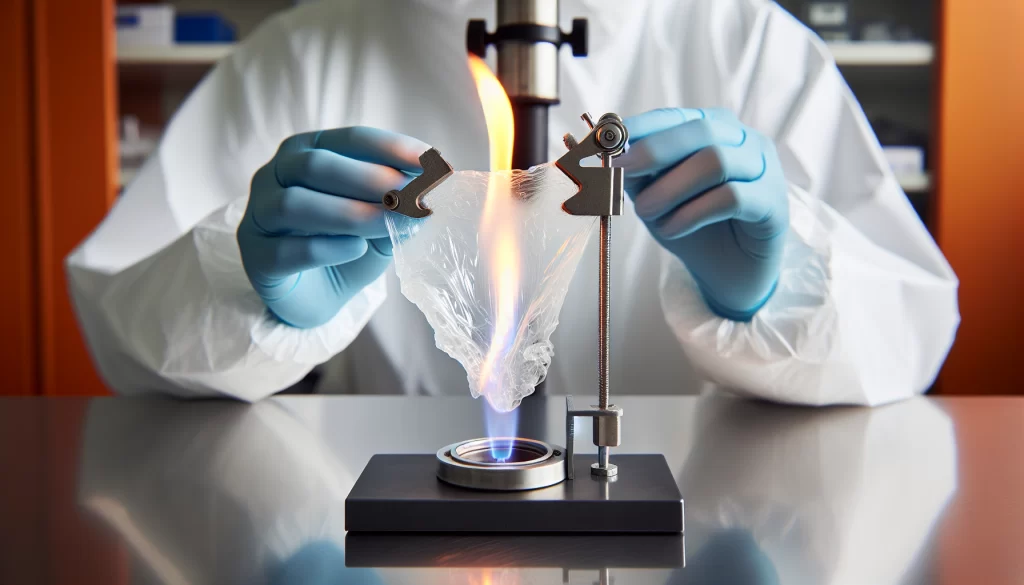
The Importance of Flammability & Burning Behavior Testing at SR Labs
Flammability and burning behavior testing is a critical process that goes beyond simple quality control; it’s a matter of safety and compliance. At SR Labs, we specialize in providing precise analytical testing that determines how your products react to fire. This is essential for materials used in everything from construction and textiles to electronics and transportation. Our testing services help you:
Ensure Public Safety: By identifying and quantifying the fire risk of your products, you protect consumers from potential hazards.
Meet Regulatory Standards: Numerous industries are governed by strict national and international flammability standards (e.g., ASTM, ISO, UL). Our comprehensive testing ensures your products meet these mandatory requirements, preventing costly fines, recalls, and brand damage.
Enhance Product Integrity: Understanding how a material burns allows for informed decisions in product design and material selection, leading to a safer, more reliable, and higher-quality final product.
Our Comprehensive Flammability & Burning Behavior Testing Services
SR Labs utilizes state-of-the-art equipment and internationally recognized methodologies to provide a full range of flammability testing services. Our analytical expertise covers a variety of tests tailored to different materials and applications.
Limiting Oxygen Index (LOI) Test
This test determines the minimum percentage of oxygen required in a gas mixture to support a material’s combustion. A higher LOI value indicates a material is more flame-retardant. This is a fundamental test for polymers and textiles.
Flame Spread & Heat Release Rate
We measure how quickly flames spread across a material’s surface and the amount of heat it generates while burning. The Steiner Tunnel Test (ASTM E84) is a key method for this, providing crucial data for building and construction materials. This testing helps classify materials based on their contribution to fire spread.

Smoke Density & Toxicity
Beyond flame, smoke is a major hazard in a fire. Our tests measure the amount and density of smoke produced by a burning material. We also conduct analysis to identify and quantify the toxic gases released. This is particularly vital for materials used in enclosed spaces like aircraft, trains, and buildings.
Vertical & Horizontal Flammability Tests (UL 94)
hese are standard tests, particularly for plastics and electronic components. In a Vertical Test, we assess if a material will self-extinguish after being ignited. In a Horizontal Test, we measure the burn rate of the material. The results classify the material into a specific flammability rating (e.g., V-0, V-1, V-2, HB), indicating its fire safety performance.
Ignitability & Fire Resistance: We evaluate a material’s resistance to ignition from a specific heat source and its ability to withstand fire for a set period. This includes tests for auto-ignition temperature and flash point, which are critical for liquid and gas analysis.
SUBSCRIBE TO OUR NEWSLETTER
Company: Asian Textile
Company: Younus Textile
Company: M son Textile
Company: Shahan Textile
Company: Abbas Textile
Company: Ahmed Textile
Company: Titan Textile
Company: Faraz Textile